Most deaths on Norwegian roads are caused by speeding, intoxication or driver error. However, statistics show that some accidents may be intentional. In 2024, around seven percent of traffic deaths are suspected to be deliberate acts.
Some fatal accidents on Norwegian roads turn out to be self-inflicted actions. Therefore, road safety and mental health must be seen in context.
Suicide in traffic is a topic that is rarely addressed. The incidents leave deep traces – not only for those closest to them, but also for rescue personnel, witnesses and other road users. These accidents differ from other traffic incidents in that the intention is considered deliberate, and not an accident.
Although the number of cases is low compared to other road deaths, each tragedy represents a significant loss, underscoring the importance of seeing the connection between road safety and mental health.
When Fatal Accidents Are Not Accidental
Since 2005, the Norwegian Public Roads Administration's Accident Analysis Group (UAG) has analyzed all fatal accidents on Norwegian roads. The goal is to understand what contributed to the incidents so that future accidents can be prevented.
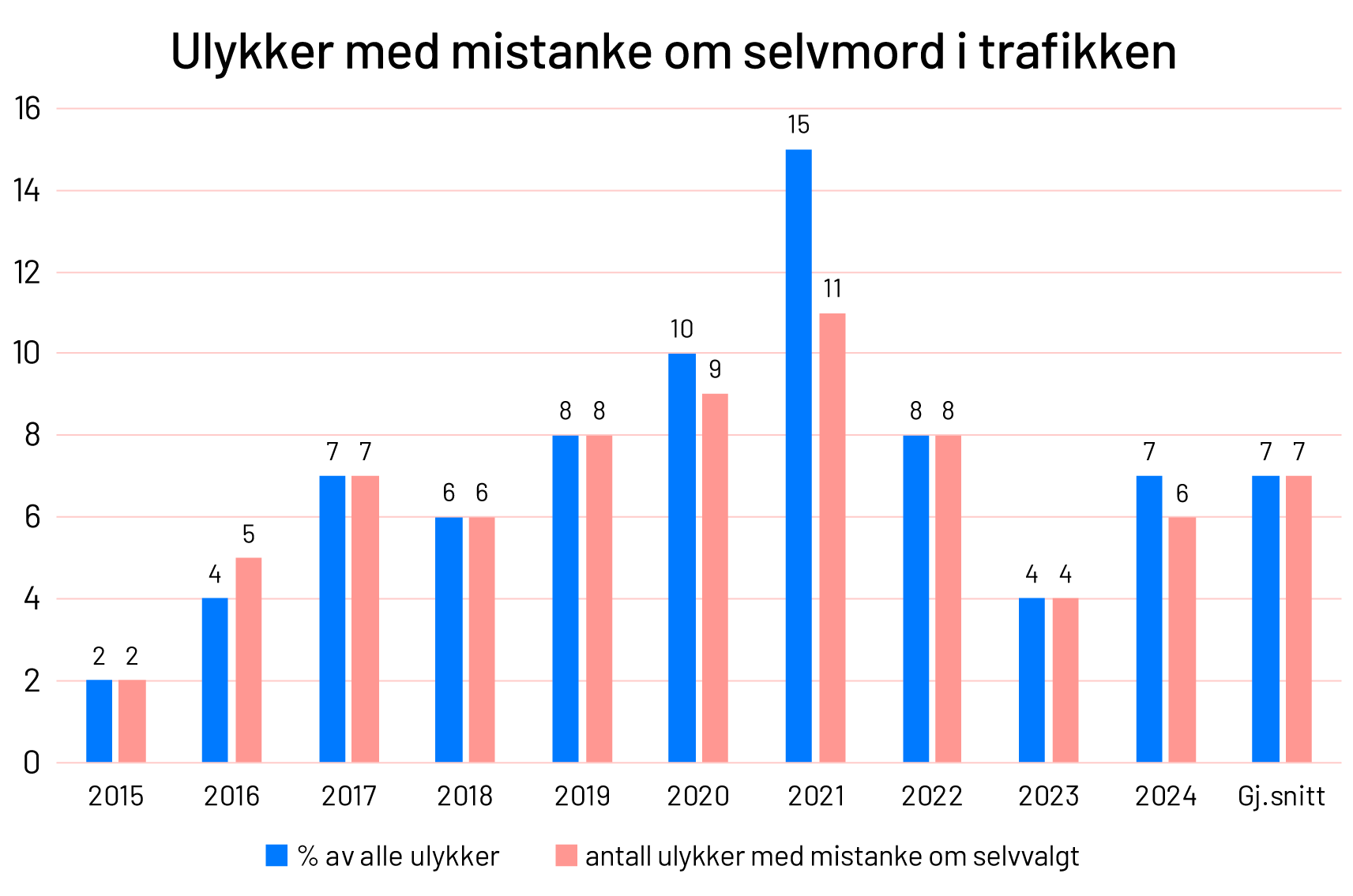
Some accidents stand out, however. Accidents where the police consider the death to be self-inflicted, or where the cause is illness, are not included in the official accident statistics. In 2024, it is suspected that six fatal accidents – about seven percent of all fatal accidents that year – may have been self-inflicted acts.
In the period 2015–2024, a total of 73 such fatal accidents are suspected. The number has remained relatively stable throughout the decade. In Sweden, it is estimated that just over one in ten fatal road traffic accidents may be a deliberate act.
Fatal accidents in the period 2015 - 2024 where suicide is suspected in traffic. Source: "In-depth analyses of fatal accidents in road traffic 2024", Norwegian Public Roads Administration, September 2025.
What drives suicide in traffic?
According to the National Center for Suicide Research and Prevention (NSSF), suicidal behavior is the result of several interacting factors – mental illness, social and economic burdens, life crises, and availability of lethal methods.
Research also shows that certain occupational groups are more at risk. People working in transportation and service occupations – where stress levels, accessibility and exposure to risky situations are high – have an increased risk of both fatal and non-fatal suicidal behavior.
Knowledge of such relationships is important in order to develop effective measures – both in working life and in road safety work.
Measures and prevention
The authorities are now working on more standardized criteria for classifying suicides in traffic. The work began in the fall of 2023, with the assistance of Swedish expert Anna-Lena Andersson, who has contributed to the development of similar models in Sweden. The goal is to establish common routines for investigation, classification and information exchange, and thereby lay a better foundation for prevention.
The report "Classification of suicides in traffic" recommends a systematic, evidence-based method for distinguishing between accidents and deliberate acts. This will provide more precise figures, a better basis for research and a stronger foundation for prevention work.
Secretary General of LEVE, Knut Harald Ulland, emphasizes the importance of the authorities' work to prevent suicides in traffic.
– The organization Leve (the National Association for Survivors of Suicide) supports the work of the authorities in this area and believes that such a systematic approach can help reduce the excessively high suicide rates.
In the railway area, the Norwegian Railway Directorate and Bane NOR have already implemented measures at the most vulnerable stations: camera surveillance, guards, cooperation with the Church City Mission, information posters and physical barriers between tracks. The experience from these measures will form the basis for lasting solutions that reduce the risk of suicide along the railway, while maintaining the safety of passengers and train operations.
A shared responsibility
Although the vast majority of road deaths are accidental, the figures show that some deaths may be due to self-inflicted actions. This underlines the importance of looking at both road safety and mental health in context. Talking openly about the topic is a first step. Increased knowledge and better systems can help save lives – both on and off the road.
Help and support
There is help for those of you who are having a hard time, or for those of you who are worried about someone.
Mental Health: 116 123 (24 hours, free and anonymous) Church SOS: 22 40 00 40
Asking for help early can be crucial. No one should have to face the crisis alone. For more information about other help options, see helsenorge.no.
One in four people fear being hit by a car. At the same time, this means that three in four drivers do not see this as a major risk – and that can be scary. The accident can happen in an instant, and the consequences are often serious for everyone involved.
Edvard Nesland knows what it's like when things go wrong in traffic. He is a former police officer with ten years of experience in the police, including three years in the Emergency Police. Half of the time he monitored traffic from a civilian car. Today he is retired and uses Safedrive.