Never before have Norwegians paid more in tolls than now. In 2024 alone, NOK 15.8 billion was collected – more than ever before. At the same time, the number of toll stations and the level of rates continue to grow.
Never before have we paid more in tolls. More tolls and higher rates mean increasingly expensive bills for motorists.
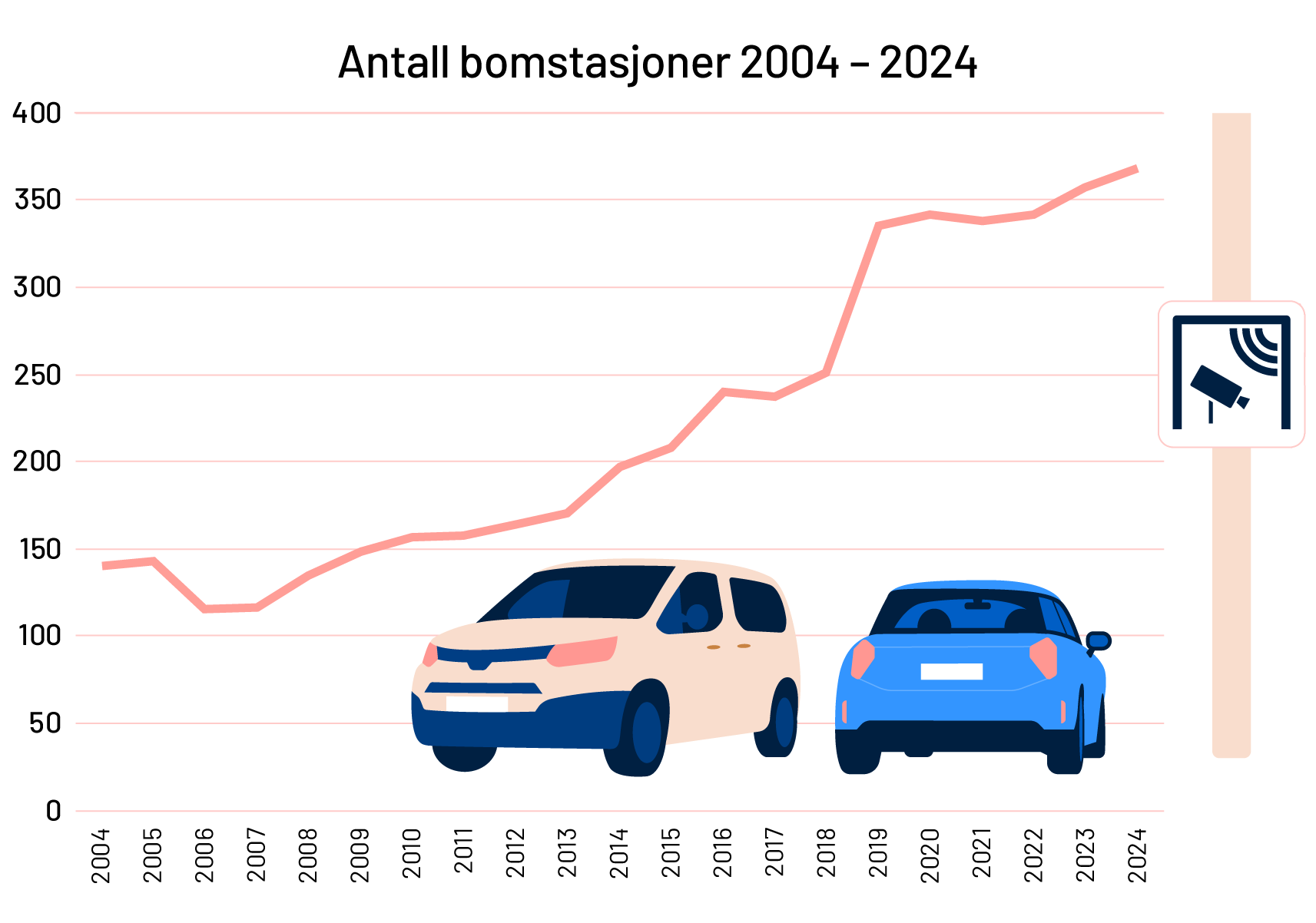
In 2026, it will be 40 years since Norway's very first toll ring opened in Bergen. Since then, the number of toll rings and toll booths has increased significantly. Today, we count 371 toll booths – almost a doubling since 2014 alone.
In recent years, toll revenues have increased steadily. In 2024, the bill for motorists ended up at a record high of NOK 15.8 billion. New toll roads are being built, and rates on existing routes are being increased. Ultimately, it is motorists who are left with the bill – and it is getting heavier.
Debt is increasing sharply
Tolls now account for 32 percent of all fees collected from motorists. In comparison, the share was only 14 percent of total car taxes in 2013, which means that the toll burden on motorists has more than doubled in the past twelve years.
At the same time as Norwegian motorists pay increasingly more in tolls, the debt of toll companies increased by NOK 7 billion in 2024. The total debt now stands at NOK 72.1 billion.
This raises concerns, including at NAF.
– The toll record of 15.8 billion kroner last year is just the tip of the iceberg. Increasing debt in toll companies means that politicians are approving more and more projects financed with tolls, says Ingunn Handagard, press manager at NAF.
The number of toll booths continues to increase drastically. Tolls now account for 32 percent of all fees collected from motorists.
– Unfortunately, tolls have become entrenched as the financing that gives politicians the fastest results. It is clear that when motorists contribute so much, the state and municipality's obligations become smaller and any increased costs can easily be pushed forward.
Hits them with bad advice
The toll system particularly affects low-income households. One in three say they cannot stand toll increases of more than 500 kroner a month – an amount that could be equivalent to the bill for motorists when a new city introduces tolls.
A survey from the Royal Norwegian Automobile Club (KNA) shows that many drivers deliberately choose detours to avoid tolls.
A total of 20 percent of all drivers state that they regularly take detours to avoid toll booths. Among those who describe their finances as strained, this applies to a full 36.8 percent. In comparison, the proportion among other drivers is 18.4 percent.
The fact that many drivers choose narrower and more dangerous side roads to avoid tolls can have serious consequences. It undermines the zero vision that no one should die or be seriously injured in traffic – one of the main intentions behind the road projects that are financed through tolls.
Electric drivers often pay more in tolls
One would think that the toll system would have less of an impact on electric vehicles, who have benefited from exemptions or lower toll rates for several years. But in many cases this is not the case.
For many years, electric cars passed through toll rings for free, a benefit that was seen as one of the most important incentives for choosing an electric car. Eventually, electric cars were also required to pay tolls – initially 50 percent of what fossil cars paid, before the government increased the limit to 70 percent in 2023.
Electric cars still pay less per pass than petrol and diesel cars. However, electric cars are not always the cheapest. Lower electric car discounts, new toll stations and price adjustments are changing the toll statistics.
Electric cars pay less per pass than gasoline and diesel cars, but have higher monthly toll costs on average due to more passes.
AutoSync, Norway's largest AutoPASS issuer, has analyzed Norwegian motorists' toll and ferry payments in the first half of 2025.
– Reduced electric car discounts are having a big impact in many places, says Svein Skovly, commercial director at AutoSync.
– This is not least due to the fact that electric cars, on average, have many more toll passes than fossil cars, he says.
Figures from Trondheim clearly show how reduced electric car discounts work in practice.
Although electric cars pay on average over 30 percent less per pass than fossil-fuel cars, they drive through toll booths 55 percent more often. The result is that electric drivers end up with a higher monthly toll bill – an average of NOK 617, compared to NOK 583 for fossil-fuel drivers, a difference of NOK 34.
Divided opinions on road pricing
One option that is constantly being discussed is road pricing. In principle, the system is simple – you pay according to how much you actually use the road. A GPS unit in the car records the mileage, and this forms the basis for the invoice. In this way, those who drive the most pay the most, while those who drive the least are charged less.
The road network can be divided into different pricing zones, with higher rates in areas with high traffic. This way, road pricing better reflects how car use burdens society, both in terms of wear and tear and emissions.
The Norwegian Institute of Transport Economics (TØI) points out that general road pricing could be both fairer and more economically efficient than the current combination of tolls and fees. In principle, the scheme could replace several of the current fees – including the fuel tax and tolls – and still ensure stable revenue for the state.
Nevertheless, opinions on the scheme are divided. A comprehensive survey of Norwegians' attitudes towards road pricing shows that the population is divided: Many are negative about both tolls and road pricing, but when given a choice, around two-thirds prefer road pricing – especially if the price level is kept moderate. Most also want the revenues to be earmarked for roads or public transport, but opinions differ on whether the money should primarily go to roads or alternatives to cars.
Another issue that often comes up is privacy. Critics fear surveillance, but researchers point out that the GPS solution could be less intrusive than today's toll rings, since data is stored locally on the chip in the car and only for a short period of time.
Politicians' responsibility
Tolls have become an increasingly heavy burden for Norwegian motorists, while the debt of toll companies is increasing. The responsibility lies with politicians, both local and national, who decide where and when tolls will be introduced.
Shifting ever larger parts of the cost onto motorists, without considering the whole picture, is not sustainable. If tolls are to remain part of road financing, political decisions must take greater account of both fairness, the economy and people's actual ability to pay.
Fuel prices have been a headache for Norwegian drivers for several years. A large part of the amount is pure taxes – and new climate requirements could make the pump even more expensive in the years to come.
Keeping to the speed limit is important. If you're behind the wheel in summer traffic, remember: Slow speed is not always safe speed. Contributing to good flow is contributing to fewer accidents.
New figures from Trygg Trafikk show that fatal accidents on Norwegian roads continue to decline. It is a development that the entire Norwegian Traffic Department has been working on for a long time, and it is going in the right direction. But instead of breathing a sigh of relief, this is perhaps the time to ask: What is it that actually works?